
What breaksFragmentation · Interoperability Failure · Resource Orchestration Failure · Missing escalation
SCN-003Coordination breakdown
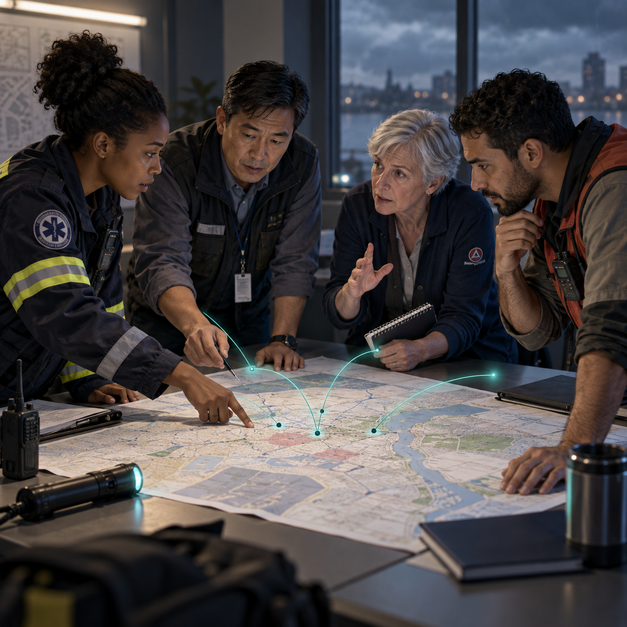
Four Agencies, One Threat, No Shared Picture.
A crisis can cross jurisdictions faster than organizations can align facts, commands and public warnings.
ScaleRegional
UrgencyImmediate
Coordination gapExtreme
StakesLife · Public safety
FragmentationInteroperability FailureResource Orchestration FailureMissing escalation
What Koali changes
← Back to the full MosaicKoali creates a source-aware common incident layer: verified facts, disputed reports, agency responsibilities, resources, public-warning decisions and updates. Agencies keep their mandates while selected information becomes interoperable.
Who holds part of the picture
field responders • dispatch • command
Koali response
Koali creates a source-aware common incident layer: verified facts, disputed reports, agency responsibilities, resources, public-warning decisions and updates. Agencies keep their mandates while selected information becomes interoperable.
Real-world parallels
- 2020 Nova Scotia mass casualty — Mass Casualty Commission
- September 11, 2001 attacks — 9/11 Commission Report
What success looks like
The relevant state remains visible across handoffs and time. • Responsibilities, unresolved questions and escalation paths are explicit.
Documented parallels show that the failure mechanism is real; they do not claim Koali would have changed a specific outcome.
Four Agencies, One Threat, No Shared Picture.
A crisis can cross jurisdictions faster than organizations can align facts, commands and public warnings.
The problem
A fast-moving threat crosses organizational boundaries. Police, fire, EMS, emergency management and neighbouring jurisdictions each update their own picture while public warnings may be partial, late or inconsistent.
What breaks
- Fragmentation
- Interoperability Failure
- Resource Orchestration Failure
- Missing Escalation
Who holds part of the picture
- field responders
- dispatch
- command
- public
With Koali
Koali creates a source-aware common incident layer: verified facts, disputed reports, agency responsibilities, resources, public-warning decisions and updates. Agencies keep their mandates while selected information becomes interoperable.
Human authority
Authorized humans and institutions retain their existing legal, professional and democratic authority. Koali structures knowledge, coordination and traceability; it does not take sovereign or professional decisions.
What success looks like
- The relevant state remains visible across handoffs and time.
- Responsibilities, unresolved questions and escalation paths are explicit.
- The outcome produces reusable memory for the next comparable case.
Real-world parallels
Turning the Tide Together — Mass Casualty Commission, Volume 5
The Commission documented critical-incident communication, public-warning and inter-agency coordination failures during the 2020 Nova Scotia mass casualty.
Relation to scenario: DIRECT
Source: https://masscasualtycommission.ca/files/documents/Turning-the-Tide-Together-Volume-5-Policing.pdf
The 9/11 Commission Report — Chapter 9
The Commission documented radio, command, situational-awareness and inter-agency coordination problems among first responders.
Relation to scenario: DIRECT
Source: https://www.9-11commission.gov/report/911Report_Ch9.htm
Boundary
The documented cases illustrate analogous failure mechanisms. They do not establish that Koali would have prevented the event or guaranteed a different outcome.
Koali loop
signals → shared meaning → evidence → choice → responsibility → action → verification → memory → better knowledge